Part 1: The Myth of the Universal Abundance
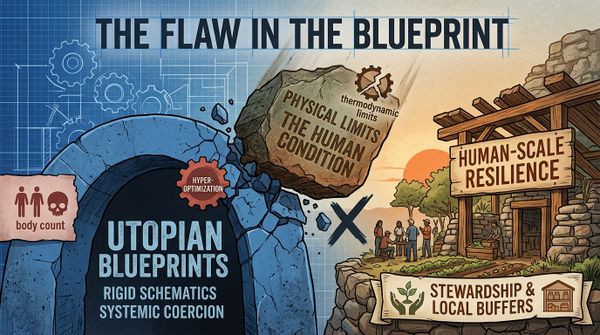
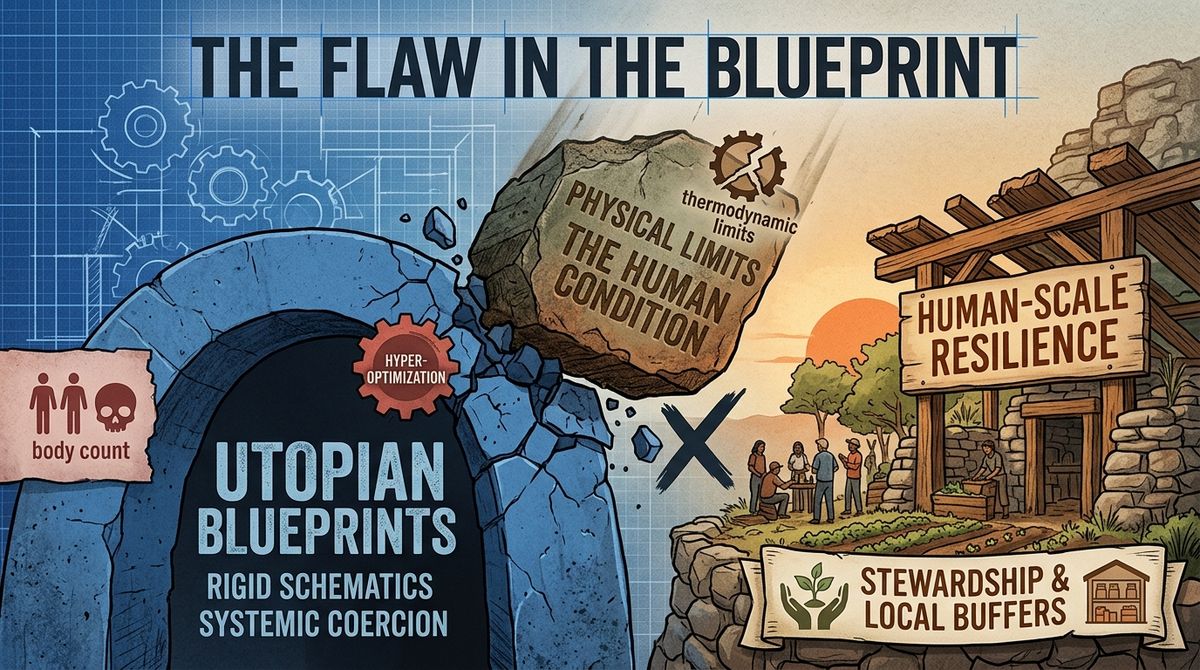
Part 1 of The Flaw in the Blueprint: Why physical limits, material reality, and human friction stop us from giving everyone, everywhere everything.

Author: Devon Douglas Levack
THE FLAW IN THE BLUEPRINT
A Four-Part Series on Systems, Limits, and Utopia vs. the Human Condition
The Core Premise
We are repeatedly told that technology, optimization, and central coordination will eventually eliminate scarcity. But virtual models do not alter physical geography, material constraints, or human nature. Before we can understand why system architects resort to coercion, we must first understand the hard physical limits that make universal abundance an illusion.
Introduction: The Silicon Delusion
In contemporary technological commentary, a comfortable narrative plays out with endless variation. It begins with a simple question: What if technology simply makes everyone rich? What if artificial intelligence, robotics, and digital leverage elevate the entire human species into a frictionless, high-consumption upper class? Wouldn’t material abundance eliminate the root causes of civilizational conflict?
It is a soothing vision for those who analyze societal progress through financial abstractions, software updates, and market capitalization. It is also an operational delusion. At its core, every grand blueprint for utopia eventually collides with an immovable wall: the human condition.
Claiming that a society can engineer a state where “everyone is rich” requires a complete detachment from the physical mechanics of the real world and the messy realities of human nature. Financial wealth is not a number in a bank account or an entry on a distributed ledger; wealth represents claim-check authority over real-world power generation, physical raw materials, and physical human labour. When tech theorists pontificate on digital platforms about universal post-scarcity, they operate in a vacuum where goods materialize out of thin air, power generation carries no marginal cost, and global infrastructure maintains itself without physical intervention.
The brutal reality is far more severe: forcing a high-consumption, frictionless lifestyle across a population without solving underlying physical constraints requires massive, structural sacrifice. Elevating an entire population to perpetual material excess requires a vast, often invisible portion of the global population to absorb the physical strain, environmental toxicity, and economic exploitation needed to sustain the system.
If a uniform, high-wealth utopia were forced into existence under current material constraints, it would not be willed into being by software code. It would be carved out through aggressive resource consolidation, systemic coercion, and a body count that strips away three-quarters of the global population just to balance the physical ledger.
I. Currency vs. Capacity: The Zero-Sum Reality of Material Wealth
The foundational error of the tech-utopian is confusing currency with capacity.
If a central authority or automated network distributed enough capital to make every human being a nominal millionaire tomorrow, zero actual wealth would be created. If every individual on Earth holds millions of dollars in purchasing power, but no one is tilling agricultural land, maintaining high-voltage power grids, mining industrial copper, processing municipal sewage, or piloting cargo vessels across the Pacific, those nominal millions are instantly worthless.
Real wealth is defined by direct access to scarce physical resources and the energetic labour required to extract, refine, and transform those resources into human utility.
The Utopian Abstraction vs. The Physical Material Reality
- Abstraction: Infinite Capital ExpansionReality: Finite raw mineral reserves & land constraints
- Abstraction: Digital Leverage for AllReality: High energetic costs for physical extraction and labour requirements that will be the slaves of the Everyone is Rich except Them Society
- Abstraction: Frictionless Service DeliveryReality: Dirty, dangerous, necessary physical labour
- Abstraction: Universal Luxury ConsumptionReality: Harsh energetic trade-offs & supply-chain limits; competition still exists in Society.
When consumption demands scale across billions of individuals, they immediately collide with three hard physical and economic barriers:
1. The Energetic and Mineral Baseline: High-standard living demands massive base-load power generation, vast raw mineral extraction (copper, nickel, lithium, cobalt, rare earth elements), and high agricultural output per acre. Software engineering cannot bypass the immutable laws of physics and energy decay. Energy Return on Investment (EROI) dictates that as primary high-grade ore deposits are depleted, the physical power required to extract lower-grade minerals rises exponentially, driving up the fundamental cost of physical infrastructure.
2. The Geopolitical Supply Bottleneck: Physical resources are geographically asymmetric. The raw materials required to manufacture advanced electronics, energy storage devices, and automated machinery do not exist uniformly across the globe; they reside under specific patches of land. Securing these materials to maintain a high-consumption baseline triggers intense, often violent geopolitical competition over ports, trade routes, and sovereign territory.
3. The Hyper-Inflation of Essential Labour: If digital leverage or universal payouts render every citizen financially independent, the pool of individuals willing to perform dirty, hazardous, and physically gruelling labour disappears. The moment physical maintenance labour becomes scarce, the cost of basic services—sewage repair, agricultural harvesting, grid maintenance—hyper-inflates. This rapid price escalation immediately re-establishes a natural economic hierarchy, stripping the broader population of purchasing power to pay for basic survival infrastructure.
II. The Invisible Floor: Structural Exploitation
Every high-standard society in human history that claimed to provide a “frictionless” existence for its citizen class was quietly anchored by an invisible, heavily exploited foundation.
- Classical Athenian Democracy: Celebrated for its political philosophy and democratic discourse, it relied structurally on unfree, disenfranchised labour to manage its mines, agriculture, and domestic spheres.
- 19th-Century Industrial Empires: Powered by rapid technological innovation and urban wealth, they were underwritten by ruthless colonial resource extraction and brutal domestic factory conditions.
- Modern High-Tech Ecosystems: The illusion of smooth, automated living enjoyed by modern consumers relies on offshored, low-wage labour in developing nations and a structurally trapped domestic service class.
- Top Level (The Utopian Illusion): Clean User Interface / High-Level Consumer
- The Invisible Floor (The Real Cost): Offshored Mineral Mining & Hazardous Processing; Underpaid Manufacturing & Assembly Sweatshops; Low-Wage Gig Logistics & Physical Transport Supply Chains; Traumatized Content Moderation & Data-Labeling Workforce
When modern platforms promise a seamless future powered by subscription apps and automated conveniences, they don't eliminate physical friction—they hide it behind polished user interfaces. The end-user paying a monthly fee to bypass digital noise or order instant home deliveries rarely sees the cobalt miner, the factory worker operating under extreme production quotas, or the underpaid content moderator filtering graphic content in the Global South.
Case Study: Platform Decay and the Economics of Fraud
This same structural dynamic manifests inside the moderation algorithms of major technology platforms. Corporate platforms frequently set high negative-sentiment thresholds—often requiring up to a two-thirds (~66.7%) negative consensus from user feedback—before taking automated action against deceptive, low-quality, or predatory advertising.
The underlying economics are straightforward: platform cleanup, human moderation, and ad verification require significant capital expenditure, whereas hosting deceptive ad runs generates immediate, high-margin revenue.
When a technology firm demands monthly subscriptions to bypass the very noise, scams, and friction the platform deliberately permits, it shifts corporate responsibility onto the consumer. The modern digital ecosystem does not eliminate the bottom of the ladder; it monetizes the decay of its own services while pushing the physical and psychological strain onto an invisible working class.
III. The Moving Baseline: Psychology and Social Envy
Even if humanity were to bypass physical and energetic constraints, a deeper psychological reality disrupts the utopian blueprint: human nature itself.
Tech-optimists evaluate human satisfaction as an absolute metric. They assume that if an individual has food, shelter, high-speed connectivity, and basic income, they will remain in a state of content equilibrium. However, human psychology does not evaluate well-being based on absolute baselines; it evaluates status through relative comparison.
Material Upgrade → Temporary Satisfaction → New Baseline Established → Relative Inequality & Envy Re-emerge
This psychological reality, known as the hedonic treadmill, ensures that as baseline material conditions improve, expectations instantly adapt to treat those improvements as basic rights. Novel relative inequalities immediately become the primary drivers of social friction, political division, and conflict.
Furthermore, human beings are not passive economic units satisfied by material comfort alone. Human drive is governed by status, competition, group identity, and the pursuit of distinction. In any social structure—regardless of aggregate wealth—status remains a fundamentally scarce, positional good. If financial capital becomes ubiquitous, status simply migrates to other arenas: access to prime physical real estate, political authority, social capital, or direct control over infrastructure.
The struggle for dominance does not vanish when baseline needs are met; it moves to a higher level of abstraction. Universal wealth does not resolve human conflict; it merely changes the weapons used in the arena.
Conclusion: The Fallacy of the Post-Scarcity Blueprint
The promise that technology will effortlessly transform all of humanity into a frictionless, high-consumption class ignores the basic laws of physics, economics, and human behaviour.
Wealth cannot exist without energetic and physical capacity to transform raw materials into human utility. Every attempt to construct a frictionless top layer requires an exploited, invisible floor to absorb the necessary physical strain. Until a society accounts for raw energy limits, supply chain realities, and the unyielding nature of human status-seeking, any blueprint for utopia remains an operational delusion—one that monetizes platform decay while ignoring the permanent constraints of the human condition.
What Comes Next
Once you accept that physical limits, resource constraints, and energetic costs cannot be hand-waived away by virtual models or economic theory, a fundamental conflict emerges.
What happens when the system architects refuse to accept these limits? What happens when a totalizing blueprint encounters a living population that refuses—or simply cannot—comply with an impossible mathematical ideal?
When the clean schematic fails to deliver universal abundance, the engineers do not tear up the drawing. They attempt to re-engineer the human beings living inside it.
Read Next in the Series:
Part 2: The High Cost of Engineering Human Nature
Why everyone, everywhere cannot have everything—and what happens when utopian design tries to force it.
If you like my writing perspective, tying history to what is going on now, then please: