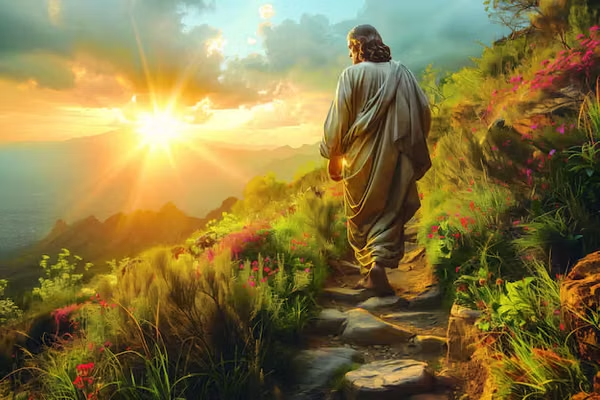
The Law of the Path Part 1: Forgiveness, Separation, and the Deception of Leadership
Why cutting spiritual and practical ties with compromised power is the ultimate act of accountability.

By Devon Douglas Levack • June 2026
Introduction: The Brutal Separation
There is a profound difference between the state of your heart and the direction of your boots. Scripture demands radical, unconditional forgiveness. When someone wrongs you, you release the debt—not for their sake, but for your own survival. If you carry the resentment, you remain bound to them. They own a piece of your spirit, and they will drag you straight into the dirt with them.
But clearing the debt does not mean inviting them back to the table. Forgiveness is a requirement of the soul; association is a matter of strict, protective discernment. You can forgive a toxic presence while actively closing the door on their access to your life. In fact, true discernment requires it. You can forgive the killer of truth, but you sure as hell do not walk down the road with him. If you do, you become a partner in your own destruction.
The Historical Baseline: The Fall of Alliances and Kingdoms
We have seen this pattern play out since antiquity. When you look at the collapse of ancient empires—including the ultimate disintegration of the Northern Kingdom of Israel in 722 BC—ruin never happens overnight. It is a long, slow accumulation of corrupted alignments and compromised character at the top. The kings and elites thought they could blend religious rituals with moral rot, maintaining an outward image of power while treating alliances as cheap, disposable transactions.
When the prophet Amos emerged from the rugged hills of Tekoa, he didn’t offer a polite diplomatic compromise to the political establishment. He looked past the gleaming exterior of a wealthy nation and applied a straight plumb line to its rotten core. He looked at the elites lounging in their luxury and stated a hard, structural law of cause and effect:
“Do two walk together unless they have agreed to do so?” — Amos 3:3
If the character and direction of a leader are fundamentally broken, you cannot walk a single mile with them without altering your own destination. Ancient Israel fell because its leaders chose to stay associated with decay, turning a blind eye to the rot until the foundation completely gave way under the weight of its own compromises.
The Present Crisis: America and the Blind Eye of the Rich
We are witnessing one of the most dramatic, visible shifts in global stability since the Second World War. A single nation’s internal fracture is sending shockwaves across the entire earth, and at the absolute center of it is a massive, systemic failure of discernment.
We see a prominent leader like Donald Trump openly demonstrating a path of self-worship, ungodliness, and deep disobedience to God. The evidence of a compromised character isn’t hidden; it is broadcast daily, operating at a relentless rate where a thousand distinct points of moral rot and deceptive rhetoric are normalized. Yet, a massive portion of the wealthy elites and institutional leaders turn a blind eye to the sheer velocity of this decay. Just like the upper classes of ancient Israel, they look past the plain evidence of rotten fruit because the association serves their short-term interests, protects their bank accounts, or insulates their comfortable “glass houses.” They mistake platform, noise, and power for true alignment, completely forgetting that a corrupt foundation always collapses. When you validate a false leader just to keep your seat at the table, you become an accomplice to the descent.
In sharp contrast to this systemic blindness, we occasionally see the prophetic tradition flash to life in the modern public square, cutting through the noise with absolute moral clarity. Take, for instance, Georgia Senator Jon Ossoff’s address from the pulpit at Beulah Missionary Baptist Church. Ossoff specifically called on the Book of Amos, invoking the ancient prophet’s warnings to directly confront modern political corruption, election denialism, and the moral responsibilities of leadership.
Drawing a straight line from the ancient text to contemporary abuses of power, he used the framework of Amos to target a “faithless president,” warning that those who abuse power and trample on justice are fundamentally broken. Crucially, though he operates within the gears of government, his address was entirely devoid of self-interest. He did not use the sacred space to endorse himself or pitch a political brand. Instead, he spoke pure truth directly to the cultural conscience, demanding that accountability be brought to the gate and closing with the unmistakable prophetic mandate that “justice roll on like a river.” This is what it looks like when the plumb line of Amos is applied correctly—a modern reminder that when leadership is fundamentally broken, you cannot simply overlook the rot. You must have the clarity to recognize the decay and refuse to walk with it.
The Geopolitical Fallout: Shaking the Dust Off a Global Stage
But the Law of the Path doesn’t just apply to individuals; it is currently rewriting the geometry of global power. Because of this profound crisis of leadership in the United States, we are witnessing the literal fracturing of the Western world’s foundational alliances.
For decades, agreements like NATO, the European Union, and the close structural bond between the U.S. and Canada were treated as bedrock. But when a nation elevates a leader who treats historic treaties like cheap real estate deals—threatening to abandon mutual defense, mocking long-standing partners, and injecting pure chaos into international stability—the world reacts.
And how is the world reacting? Exactly how the scriptures dictate. They are turning away.
Traditional allies are not engaging in a screaming match; they are quietly realizing that they can no longer walk down the same road with a compromised superpower. We are seeing Europe aggressively forge independent trade agreements that bypass Washington. We are seeing Canada and the EU reinforce their own networks, securing their futures away from an unpredictable and transactional American center. The message from the global community to the United States is clear, even if the American public fails to see it: “We will forgive the instability of your past, but we can no longer trust you to walk with us into the future.” By presenting himself as an ungodly, untrustworthy partner, this central figure has systematically isolated the very nation he claimed he would elevate.
The Blueprint for the Future: Apostolic Instructions
This is exactly what Jesus, Paul, and John were trying to warn the early churches about as they looked toward a fractured future. They knew that false leaders would rise within the community—people claiming the title of authority but failing entirely to lead by example.
- Jesus’s Standard: Christ loved, fed, and healed the masses unconditionally, but He guarded His inner circle with absolute, relentless intent. When He sent out His followers into environments that rejected the truth, He didn’t tell them to linger, argue, or compromise to keep the peace. He gave them a concrete, physical action plan: “Shake the dust off your feet” (Matthew 10:14). You leave the dust behind so it doesn’t contaminate the journey moving forward.
- Paul’s Mandate: Paul was completely uncompromising about who we choose to associate with. In 1 Corinthians 5:11, he explicitly instructs the church to separate from anyone who claims the faith but lives a life of active greed, arrogance, abuse, or deceit—stating, “with such a person do not even eat.” Paul didn’t offer exceptions for political expediency.
- John’s Boundary: John echoed this warning with razor-sharp clarity in his second letter, stating that if someone comes to you operating outside of the truth, you do not welcome them into your house or validate them, because to do so makes you a partner in their compromised works (2 John 1:10-11).
Moving Forward: How “We the People” Strip False Leaders of Power
As we look at the wreckage of society today, the question becomes: how do we as individuals react to this global breakdown? The answer is both incredibly simple and profoundly disruptive. We must turn away.
The illusion of power held by false leaders—and the elites who back them—depends entirely on our willingness to follow them, to give them our attention, and to engage in their circus. Amos was just a lone shepherd, a working-class civilian from Tekoa, but by standing firm and refusing to bow to the royal sanctuary at Bethel, he exposed the corrupt establishment as utterly powerless.
Similarly, Jesus did not pick up a physical sword to overthrow the corrupt religious establishment of His day. Instead, He stood before the Pharisees, spoke right over their authority, exposed their internal hypocrisy, and walked away. He showed the people that the legalistic systems holding them down were spiritually hollow and completely empty of true divine authority.
This is how we hold these broken structures accountable today. We do not need to fight them on their terms; we simply need to stop supporting them in any way. When “we the people” apply true biblical discernment and collectively turn our backs on corrupt leadership, we actively demonstrate that they have no real authority over our souls, our families, or our direction. By choosing absolute separation, we strip them of their fuel. You forgive the brokenness, you release the anger so it doesn’t poison your own heart, but you look at the rot, you understand exactly why it is wrong, and you walk away.
By God, you have to separate yourself from it.
References & Knowledge Resources
- The Book of Amos, Chapter 3: Focuses on the structural inevitability of cause and effect (”Do two walk together...”), challenging the illusion that external prosperity or military muscle equals moral alignment.
- Senator Jon Ossoff Address: Delivered at Beulah Missionary Baptist Church (Atlanta, GA). Invoked the prophetic warnings of Amos to confront modern political corruption, election denialism, and the moral responsibilities of leadership from the pulpit.
- 1 Corinthians 5:9-11 and 15:33: Apostle Paul’s strict behavioral boundaries regarding personal association and the cumulative, corrupting influence of bad company on character.
- 2 John 1:10-11: Apostle John’s letters to the early Christian communities outlining the spiritual hazards of validating, welcoming, or greeting false teachers.
- Historical Records of the Neo-Assyrian Empire Expansion (8th Century BC): Documenting the structural and political disintegration of the Northern Kingdom of Israel due to compromised internal leadership, spiritual decay, and failed foreign vassal policies.
- Matthew 23 (The Woes to the Pharisees): Christ’s direct, public exposure of leadership that demands compliance from others while failing to live out justice, mercy, and faithfulness themselves.
- Modern Geopolitical Trade Realignment: Tracking the shifting strategies of the European Union and Canada as they establish independent economic and security frameworks to insulate themselves against transactional and unpredictable U.S. foreign policy shifts.